Follow on Twitter

Friday, 5 August 2016

Saints and Cynics Day 10: Puente de la Reina to Estella

Puente de la Reina to Estella 22km (223 km cumulative)

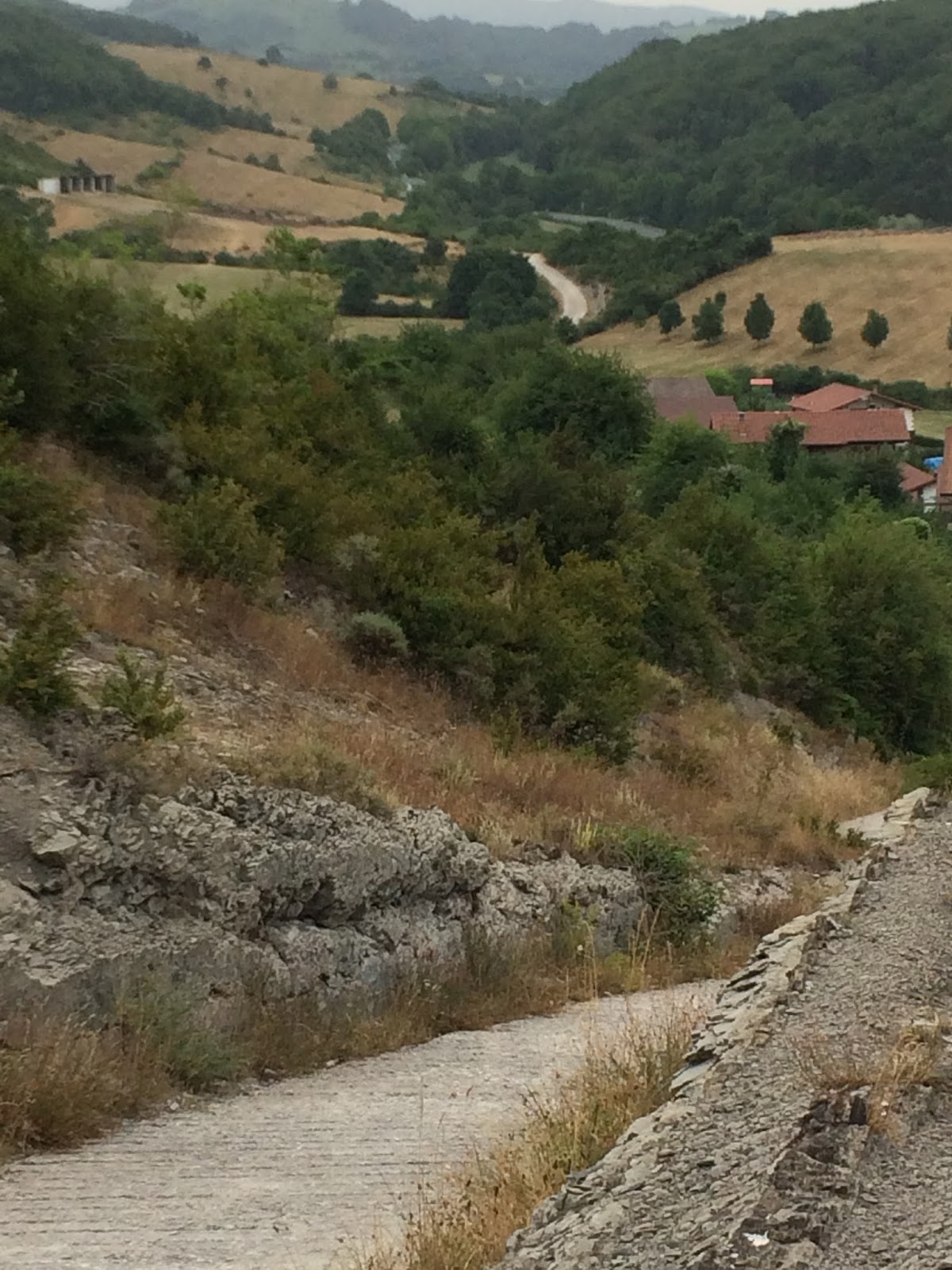
It's Sunday 24th July, it's day 10, and I'm walking to Estella from Puente la Reina, started off about 08:30 this morning. I'm about an hour away, I suppose [no you weren't, it was more like two]. I can see the cathedral, behind it I can see a mountain rising up to the left and then a very small, conical hill, straight ahead of me which is, I think Villamayor de Montjardin. Over to the right, to the north-west are the Basque mountains and in a sense this Camino is a Camino with mountains always on the horizon, untouchable. In the Pyrenees, now in the hills of Navarra and of course, most tantalisingly, across the Meseta when you ca see the Cordillera Cantabrica to the north; that's a real bummer. 
The weather is very pleasant, sunny; very small cumulus clouds, ooccasional shade. There's a nice wind, it's a lot less hot than it was a week ago when I limped, dehydrated, into St Palais. And I've become a laggard, as such it's relatively quiet from Lorca into Estella.


I'm just so relaxed; so laid back. This is fantastic walking; again, I'm almost at the point of tears. It's as if I haven't fell like this for a long, long time; indeed, I probably haven't felt like this for a long, long time. I probably haven't felt like this since the summer of 2012 [when I walked the Camino Frances for the first time] or maybe 2014 on the Camino de San Salvador. The emotions are stronger, the intensity of tranquility, if that's not an oxymoron. 
To what extent is the landscape involved? This landscape - I don't remember it from last time; it all seems new, even though it's only four and but years since I was last here. I don't remember the hills, I don't remember the Basque mountains being on the fringes of the landscape though that's probably because I'm now more obsessed with the Basque mountains and because I've visited them.
I'm much more aware of the context of the Camino within the whole Spanish/Basque landscape; the Basqueland, the Basquescape.

Cirauqui - classic hill-top town


It feels emotional, it feels ... comfortable ... no, not comfortable, it feels like a landscape which I feel very part of. I feel more at home, more attuned to this landscape than I would, now, to landscape in the UK, even in my beloved Wessex. And part of this Camino is about being on the run, the sense of being a refugee ... I'm always on the move and when I wasn't on the move in Pamplona on Friday I was a grumpy git. 
I just wanted to record this to show how the landscape is having this affect ... it's difficult to describe how I feel. It's almost ecstatic but in an way that isn't ecstatic - can one be calmly ecstatic? it feels perfect - just rolling along, dwelling in this landscape.


The path is always the centre of attention, the focus of the visual and embodied gaze


I was thinking about yesterday's hike down from the Alto del Perdon to Puente de Reina, how you begin to get this procession of villages and from there the path. Not just this path but lots of paths; it's a landscape full of ways, a landscape full of routes, full of possibilities. One dwells in it, one walks through it, one follows a very clear path defined by its yellow arrows but that's not all one sees.

I wanted to think about becoming. This is Day 10, it's the ninth day of walking. One is constantly becoming, one never does become, one never gets to the 'ser' [essence], one is always 'estar' [transitional state]. But what I feel today is that I'm becoming part of the landscape, that a particular spell cast by the landscape is beginning to work, possibly helped by the weather, and it's becoming very strong.

The distant Sierra de Loquiz from the Camino near Estella

I do intensely feel part of this landscape and if somebody were to come along and try pluck me away from this I would get physically violent. The only way I would leave this Camino now would be in a coffin, even if I were to sustain an injury I'd still hang around. This is where I belong, there's nowhere else I need to be. it's a bit like the day of my operation [twenty years ago]; I remember thinking then, looking out of the window of my hospital room, there's nowhere else I want to be. All sorts of things could have going on elsewhere, I wanted to be there. it's the same feeling, which is a little bit weird, I suppose, but maybe that's significant.
 

Tuesday, 2 August 2016

Saints and Cynics: The Meseta

You know you want to be here ...


The Camino de Santiago - or more accurately, the Camino Frances - is often divided into three sections each of which describes the nature of the suffering the pilgrim experiences as she/he moves from the south of France to the holy grail that is Santiago de Compostela.
The first stage, from St Jean Pied de Port to Burgos, over the Pyrenees, through the foothills and the rolling landscapes of Navarra and Rioja are characterised by physical suffering as the body becomes attuned to its daily diet of getting up, putting on boots, walking, taking-off boots and sleeping, with little more than pintxos, bocadillos and cold beers inbetween. It's gruelling, at times, but it''s not that tough; the scenery distracts and even if that begins to begins to pall there's tremendous entertainment to be had in observing - and even participating in - the formation of friendships and the beginning of families across linguistic and cultural divides.
And because it's the Camino, it works. Believe me, I'm a world-weary cynic but even my inner misanthrope is won over by its spirit, a spirit which works in material as well as metaphysical ways, just in case you're worried I'm getting a little bit too wishy-washy.  
But I've been 19 days on the Camino, hiked 370 kilometres, and I'm beginning to feel reasonably trail-fit. You know you're trail-fit when you can negotiate steep slopes without pausing for rest or even getting out of breath; this I suceeded in doing yesterday when ascending 300m from Villafranca up onto the Montes de Oca during a quite mesmerising day's walking. I have now become part of the Camino, physically and spiritually; if you wish to remove me you'll have to do it by force and I'm willing to bet that one of us won't survive.
Odds-on it won't be me. I'm a woman possessed.
But today, on arrival in Burgos, that physical suffering came to an end. Tomorrow begins the second and most ominous of the three stages, the one I fear the most. Tomorrow begins the Meseta, the torment - and believe me - that's sometimes how it feels, switches from physical to emotional. I know which hurts the more.
To the uninitiated, the Meseta is Spain's high, central plateau ranging from 500m to 1000m metres in altitude. It takes the concept of flatness and straightness to new dimensions; in the winter it's cold and blasted by bitter winds, in summer it's hot and the air doesn't move. Across the Meseta, from Burgos to Leon, the Camino abhors sinuosity and opts for the long and the straight and the narrow. One can walk for hours without coming across a bend or deviation; if you let it, the Meseta will torture you into submission and you'll look north to the mountains of Leon of the horizon wondering what the fuck you're doing spending a week of your life crossing this wasteland.
Been there, done it. And tomorrow I'll be back for more. I hate the Meseta so much I love it.
In May 2012 I stormed across the infamous 17,5 km almost entirely straight section of the Camino Frances from Carrion de los Condes to Calzadilla de la Cueza in just over three very angry hours. It was a Sunday morning, and I wanted it back; I was so angry that even when I finally came across human habitation and ice-cold Coca-Cola I turned my back on it; if you'd have asked me how I was feeling I'd have overturned your table and told you to fuck right off. 
But as The Pretenders once sang, it's a bitter line between love and hate. Last summer, after the hiking the vertiginous Camino de San Salvador through the Cordillera Cantabrica, I returned for a 38km one-day hike across the Meseta for no other reason than to experience that torment once again, even though I already knew I'd have to return again this year as part of my fieldwork.
What's going on here? For the past three or four days, even as I sat in the dentist's chair in Logroño, I've been thinking about the Meseta, preparing myself. Tomorrow it's going to happen. I can't wait. 
Believe you me, one way or another it'll end in tears. See you on the other side.
The third stage? It's spiritual suffering. That begins in the mountains; if you're still in one piece - physically and mentally - strange things will happen.

Saints and Cynics Day 9: Pamplona to Puente de la Reina

Pamplona to Puente de la Reina 24km (201km cumulative)

Day 8 was a rest/writing-up day. I don't, as a rule, like rest days but I generally succumb more often than I'd like. They break both the rhythm and the tension between landscape and pilgrim/hiker; it's only 24 hours but you still have to get going again after the break. In May 2012, after only three days on the trail, I made an impromptu stopover in Pamplona to see if the 15-M Indignados demonstrations might kick off. They didn't, I should have carried on then, I really should have carried on today but you know what they say about those who ignore history ...

Pilgrim's donkey tethered outside a bar in the outskirts of Pamplona. It's not the first time I've witnessed a beast of burden on the Camino, in 2014, on the Meseta, I encountered a Frenchman who'd walked all the way from Paris with a mule.


The Camino, well-marked and well-trodden, wends its way out of the rather plush suburbs of Pamplona up to the Alto de Perdón through fields of barely and of rye. That Tennysonsian refrain will accompany my fellow pilgrims and me for many, many days. Best you have no aversion to a landscape that's golden blonde.


As we paused for to rehyrdate, a passing local informed us, overly gleefully, we thought, that this was once a witches castle. I ventured to suggest that in the twenty-first century it might appropriately resurrect itself as an S&M club, though I didn't translate it into Spanish!

Looking north (above) to the Basque mountains and east (below) to Pamplona, whence we'd come on a leisurely Saturday morning


Are you gonna come my way? (It didn't)


The mountains to the north-west of Pamplona are characterised by limestone cliffs and crags. From the south, from the Camino, they resemble a cuesta and scarp landscape, impressive but not intimidating. Seen 'head-on', however, from the east or the west, they look much more shapely.


The summit of Alto de Perdón (Heights of Forgiveness). The climb looks worse than it is - not much more than a bracing stroll - and the pilgrim is rewarded not only with wide views looking back and looking forwards, but this sculpture dedicated to all the pilgrims who walk the Camino. The inscription reads donde se cruza el camino del viento con el de las estrellas: 'where the path of the wind crosses that of the stars'. 


Can you feel it? This is the view, looking west, that got my hot and sticky landscape juices flowing back in May 2012 and did so again, in 2016. Having left the Pyrenees and Pamplona, the Camino now strides out boldly across a more open landscape, into the distance, towards the horizon and beyond. I asked two fellow pilgrims with whom I was walking if they, like me, could feel the profound change that had taken place in the landscape merely by traversing the Alto de Perdón. It took them a while, but as we began the stony descent the finally succumbed.


Wind turbines on the Alto de Perdón ridge

You get your photo taken at the Alto de Perdón, you pick it up in Puente la Reina the following morning. A nice - and worthy - little earner ...


Virgin secreted in the landscape, one for the Catholic gaze.


Church of Our Lady of Arnotegui, Obanos. Home to the Mysteries of Obanos,a legend acted out in the village every two years: 'and Guillén, flushed with fury, finally urged his sister Santa Felicia to leave the lands of the town of Obanos. She refused, and the Duke of Aquitaine, in a fit of anger'.


Up on the ridge, in the centre, is a hermitage. Below, in the valley, the Camino Aragonese that has crossed the Pyrenees at the Pass of Somport joins the Camino Frances and together they enter Puente la Reina


So far the hike has taken on a much more Catholic aspect than I'd anticipated, it's been much more spiritual ... and ... I think there's a lot of stuff here about the Catholic gaze, the Catholic gaze being more than a visual concept ... being also very much sensual ... the Catholic gaze has to be sensual, involving all the senses. And, perhaps with the bells yesterday ... perhaps that becoming important.
Recorded Saturday 22 July 2016

Friday, 29 July 2016

Saints and Cynics Day 7: Zubiri to Pamplona

Zubiri to Pamplona 25km (182km cumulative)

At times, during the winter and spring of 2015/16, my student warden cell - I mean bedsit - resembled a World War Two operations room. So many maps and guides, to the casual observer it might have seemed like I was planning an assault on norther Spain.
Which isn't so very far from the truth.
I sat, I planned, I drank gin and tonic. I walked the Camino Frances - and several others - time and time again, in my imagination, on the map. I drank too much, I planned too much; it was always going to go arse over elbow when I finally got my feet on the ground. 
Like many pilgrims, I overestimated the first stage of the Camino Frances and thought that, once I'd gone up and over, the rest would be plain sailing. Somehow, perhaps after a night of particularly fine gin, I'd reckoned I could walk the 38km from Burguete to Pamplona.
No effing way!
That much became apparent with the first few kilometres of yesterday's walk so I quickly hopped on to the internet and booked a room at a very pleasant pension in Zubiri. Couldn't do that in 2012; in 2012 I'd spent an unpleasant night at the municipal albergue in Zubirir which had crammed in far too many pilgrims for the limited facilities. Nowadays, Zubiri, like many towns on the Camino Frances, has three or four albergues plus pensions, hostales and hotels. Spoilt for choice, I don't know what the purists would say. Not that I really care. 

Back to life, back to reality. First up out of Zubiri is the Magnesium fabrica, which sprawls alongside the Camino for a couple of kilometres. Many moan, but over breakfast mine hosts at the pension told me the plant employs over 250 people, without it the area would be reliant on tourism and that, as any decent geography student will tell you, is not a good thing.


I was walking on my own for the first part of this stage so I didn't overhear any comments about incursions on and ruinations of nature; I guess there are many pilgrims who think the plant should be shut down and nature be allowed to reclaim the landscape. I'd have had to remind them, of course, that all human activity is nature and that the magnesium processing plant was as much part of the landscape as the churches, abbeys and cute little Roman bridges.


The magnesium process plant kept me entertained for a good half hour; I was fascinated the by the both the geometrical patterns of these slag heaps but also the mechanics that kept them stable. Many, many years ago I worked in a soil laboratory and then, in a period of my past that really ought to be consigned to history, attempted to study for an MSc in Geotechnical Engineering at what was then the Bolton Institute of Higher Education. Needless to say, I failed spectacularly but 26 years later the filthy lure of soil hasn't lost its attraction.


'Circles in the sand/'Round and 'round'


Shortly after the fabrica I came across a right little gem in the shape of the Abbey of Eskirotz and its Church of St Lucy. The church, its adjacent house and grounds are currently being restored by Neil from South Africa. More details on the Abbey's Facebook page: https://www.facebook.com/theabbey.es/: suffice to say that the place is a veritable web of intrigue with enough occult spirituality to make The Da Vinci Code look like a Janet and John narrative. Buried moors, parish politics, repressed Virgin Mary and Templars (obvs); they're all here. Well worth more than a cursory visit if you're passing by.


Santa Lucia. The church appears to have been originally dedicated to the Virgin Mary. Why was she demoted?


The door - not the original - had once been painted with stars but these have, in turn, been painted over. Is somebody trying to hide something? I feel a Holy Grail plot narrative coming on ...


The church of Santa Lucia from the outside. Much restoration still to be done inside but it's an exciting project.


Path of the Day. Nice, easy walking down to Pamplona.


Altarpiece, Church of San Esteban, Zabaldika, overseen by the Sisters of the Sacred Heart. Pilgrims are allowed to climb the tower and ring the bell tower once. A deeply moving experience, the hospitaleros at the adjacent albergue were also very, very friendly. It's just ten minutes up the hill from the Camino, worth the effort of the short climb.

And what's this? Not a Virgin and Child but a stepfather and son (17th century)


Looking back up the valley before the Camino enters the outskirts of Pamplona


 Trinidad de Arre, outskirts of Pamplona. Close to here the Camino Baztan joins the Camino Frances.


Tuesday, 26 July 2016

Saints and Cynics Day 6: Burguete to Zubiri

Burguete to Zubiri 19km (157km cumulative)

It's inevitable, really. After the ecstasies of crossing the Pyrenees, the second stage of the Camino Frances has the potential to go a bit 'after the Lord Mayor's show'. For the past five days the mountains have been in the foreground, creeping ever closer until you could touch and feel them. From now and for the next three weeks they'll be in the background, on the horizon, tempting and tantalising. It's enough to make you weep.

The Road goes ever on and on ...

Back in 2012 all this was new to me and such was the intensity of the experience as I hiked across the Pyrenees that the following few days exist in my memory as little more than a blur, a landscape I could barely recall. So, four years later I was expecting ... well, not disappointment but certainly a lowering of excitement levels as the Camino filed down the Arga valley towards Pamplona and hordes of pilgrims followed its line. 
Landscape and memory, like the glorious decade that was the 1980s, the way we remember our environs isn't often the way it might have been. We spin an alternative narrative to the events as others might have recorded them, which doesn't mean to say that one's the truth and the other's a wilful falsification. In 2012 this stretch of the Camino had its vitality eroded - or perhaps 'sucked out' - by the presence of the adjacent Pyrenean 'elite' landscapes. These Navarran foothills live in the shadow of their illustrious neighbour and back in 2012 my gaze was forever directed north, towards the spectacle.
But you know what, you can re-walk the same trail over and over again and every time it's a different creature, revealing some hitherto invisible trait. When it comes to landscape, familiarity most definitely doesn't breed contempt, rather, it deepens one's presence, blurs that thin line between subject and object. I become the land, the land becomes me.

The first stages of the day's walk and the path has become playful. Unlike yesterday this isn't serious stuff; time to chill out and lighten up. A footbridge here, a set of stepping stones there; the grandiose canvases of yesterday give way to a track that ducks and dives, ebbs and flows.


The hills have shrunk in size but they can still pack a nasty punch. The pilgrim, still congratulating herself for her exploits over the Col de Lepoeder, still conjuring up tales she'll spin to her mates back home in the pub, in front of a blazing log fire, thinks she's done it all. But the path has a trick in its tail and, when you're not looking, it's liable to spring a surprise or two. This ascent, small but juicy, packs a mighty punch and will suck the life from limbs still delicate after the previous days exertions.


One of the great joys of this Camino is the trajectory of the path itself, sometimes snaking, sometimes hitting out in a straight line but always carving its presence in the landscape.  You can look back and see from where you've come, you can look ahead and see where you're going. You can take the landscape out of the Camino but you can't take the Camino out of the landscape; the track puts everything in its place.


As if I ever would! Second time passing this sign, it now seems almost oxymoronic